Wednesday, January 11, 2012

DANCING IN THE NEW YEAR


At the beginning of the New Year, Yashodhara Shelter welcomed several visitors.
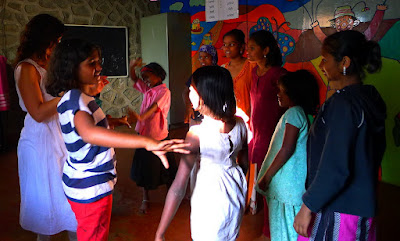
From Girona, Spain, came Coral Ríos – director, teacher and dancer at Itzà Dance School, who is also a sponsor of a girl from Yashodhara and a regular contributor to Asha-Kiran’s work in Spain. From Portugal, a week later, came dancer Carolina Fonseca, member of the group of teachers of the project "Dancing Leprechaun" created by Myriam Zsabo (Yumma Mudra).

Given the children’s passion for dance, we organized a few short movement, self-expression and free dance workshops. Both dancers were equally amazed at the creativity, the explosive energy and the ease in bodily expression of Indian children.

Delighted with our Projects, Coral and Carolina left saying a "see you soon". Carolina began a tour through India tour to deepen her knowledge of folk dances, and has the intention of visiting us again to share her art with the children.

We are thankful for such special and ‘danced-to’ encounters.

Eshana - live-in Volunteer at Yashodhara Shelter


Thursday, January 5, 2012

INTERNATIONAL DAY OF THE FEMALE CHILD


By decree of the United Nations, October 11 of 2012 will be the first International Day of the Female Child.

This achievement has been possible thanks to the support of the Government of Canada, responsible for raising the proposal to the United Nations General Assembly. The initiative has also had the support of the governments of Germany, El Salvador, Guinea Bissau and Pakistan.

The Director of PLAN, the Spanish organization that backed up the creation of this day in the international calendar, has stressed the significance of this achievement: “So far there was no day that focused specifically on the situation of girls, one of the most discriminated social groups and for which there are very few concrete policies. In many countries, girls are marginalized in all facets of their lives, from school to work. In the worst cases they are not even allowed to be born”.

Sixty two million girls do not attend school and about 140 million suffer sexual mutilation, while ten million a year are forced to marry before the age of 12. Moreover, they make up ninety per cent of all minors who work in domestic service; each year, the number of girls trafficked with is ten times higher than during the heyday of slavery.


Who wants to educate or invest in the education of a girl whose only future is, according to her parents, to marry and have children?

An international day is much more than a date in the calendar - it is a window, an open door, a spotlight that focuses, in this case, on the most vulnerable among the vulnerable. If we do not invest directly and specifically in the female child ensuring her access to health, education, protection and allowing her vital and emotional development, we will not meet six of the eight Millennium Development Goals.

In Spain, 6500 people signed the petition for the having an International Day of the Girl Child and 35 leading companies contributed to spread the message of support to girls, as well as to finance education projects for them.

Let us also contribute, from our own individual possibilities, to empower girls (and boys) so they can become the world’s redeeming force.


Sources: Fundación Luis Vives/Ameco Press/El País/epsocial

Monday, December 26, 2011

EXCURSION TO ALIBAG


On 17 December, the children from Yashodhara went to Alibag, a beach near Mumbai. For some, it was the first time they had seen the ocean. At first we had contemplated going to Matheran, a mountain pass and natural reserve, but the children wanted to go to “samudra” (beach, in Hindi) and spent all day talking about how much they liked to play in the sea. In the end, their wish came true.


They were thrilled to be going and got their clothes ready (in India, people bathe with clothes on) and a towel. During the bus journey, they listened to music, sang songs and attentively watched all the new scenery.


They bathed and played in the water for three hours, until lunchtime. They then had a picnic in a very nice garden near the beach, with hammocks and showers. After lunch, some of them rested in the hammocks. Hansa, Co-founder of Asha-Kiran, accompanied us and enjoyed the excursion as much as the children did.

On the trip back Home, they were all still and quiet, filled with the lingering scent of the sea and its treasures.

Eshana – live-in Volunteer at Yashodhara Shelter


Wednesday, December 21, 2011

JOY OF GIVING WEEK


Joy of Giving Week (JGW) is India’s “giving festival”, held every year the week of October 2-8. It is a platform that brings together people from all walks of life and encourages them to celebrate by giving – time, money, skills or love; a concerted effort across NGOs, companies, celebrities, media, schools, colleges and the “public”. Started in 2009, this was the 3rd edition of JGW, which is already by far the largest philanthropic event in India.

JGW is a public festival, much like Diwali, Holi, Christmas, etc. Participation is free, open to all, and you can give anything from a piece of clothing to lacs of rupees, a few hours of your skills to a day or two of your time. Event owners are free to manage their events to achieve their objectives. All of the proceedings from the event go to causes that organizers choose with lots of media support.


Asha-Kiran Shelters Foundation also participated in the ‘Joy of Giving Week’ of 2011. Since we could organize our own events, we created the following two:

- The Power of One
- Recycle for Reuse


These were held across different companies with the aim of creating awareness and raising funds for our Organization.

The Power of One

This was our flagship fundraiser and many found it a unique concept. It may not be possible for many people to donate large amounts or even to sponsor a child, but this modality of donating allows people to contribute with just one rupee a day, or 365 rupees a year, so this One rupee, multiplied by thousands, can make a cause close to their hearts come true. Many people participated as they found the amount affordable and also promised to do it every year.


Recycle for Reuse

Over thirty eight percent of our total waste comes from paper and paperboard, so we thought of bringing back this great tradition of recycling newspapers while raising funds for our Organization and helping the environment. People were asked to donate their old newspaper, which was then sold by weight. Almost everybody who heard about the campaign participated and donated their newspaper.

Both these events were conducted at four different companies in Pune and approximately Rs. 1.48,144 were collected in total. The companies that participated and helped us raise funds were:

- Piaggio Vehicles Pvt. Ltd.
- Nihilent Technologies Pvt. Ltd.
- Cybage

WE THANK all the companies and people who contributed to bring a "ray of hope" to the ones who need it.


Saturday, December 17, 2011

MERRY CHRISTMAS


This year, we are celebrating Christmas at Yashodhara in the company of new friends. Students of Celia Viñas High School in Almería, Spain, sent our children cards which they themselves had made by hand, with a short text in English. We thank Mª Angeles Arráez, Sponsor of one of our children and co-worker at
Asha-Ki
ran
, for dreaming up and organizing this initiative. Upon reading their cards, the children had a drawing workshop so that their pen pals from Almería would receive a speedy reply.

In December we also celebrated Pravin’s birthday, who, like all of his housemates, enjoyed a table-football game given to him by his Sponsor. The interaction between children and their Sponsors is a source of gratitude, generosity and mutual affection, because the children feel accompanied in their growing process. Not a day goes by without their asking about their Sponsor and expressing their desire to see him or her at Yashodhara.

We heartily thank all of you who, by supporting our Projects, grow together with the children you sponsor.

Sunday, December 11, 2011

CAUGHT IN RED TAPE

Ten-year-old Salina Khatun was denied admission by the neighborhood school as her illiterate parents failed to produce a birth certificate. Her parents work in a brick kiln and, like thousands who are constantly on the move in search of livelihood, paperwork is as distant to them as their rights.

Close to two years since the much feted Right to Education Act came into being, the status of school education continues to be plagued by lack of awareness, assertion and access, especially among the communities which need it the most for the transforming potential it has on poverty and social empowerment.

A public hearing in Kolkata’s Town Hall threw up some answers as to why, despite the greatest constitutional recognition and substantial resources, the status of school education continues to be in a poor state.

The hearing was organized by the National Commission for Protection for Child Rights (NCPCR), on the issue of denial of the right to education. It was supported by a host of organizations, including Action Aid India, who painstakingly collected stories from the field to build a case for a jury to issue directions on making it work.

For millions who live on less than an euro a day, and for a nation where over 40 per cent of the children are malnourished, free education and mid-day-meal provisions are key conditions for school education to work.

Incidentally, the officials from the state education department who were called in for responding to the cases of violations did not deny any of the allegations. This led the NCPCR to suggest a penalty of Rs. 25,000 as a fine for violations to the law. The hearing expanded to a discussion on trafficking and it became apparent that a functional schooling system is the best defense against this practice.

"It seems that the issue is not of resources but that of will", NCPCR Chairperson Shanta Sinha said.

Wednesday, December 7, 2011

A NEW CELEBRATION

Sai Baba was an Indian guru, considered a saint by his devotees. It is a well known figure in many parts of the world, but especially in India, where he is widely worshipped. To celebrate his anniversary on December 9, the campus which houses Yashodhara Shelter conducted a program of activities for the approximately 160 children from various NGOs that work with socially disadvantaged children or with mental and physical disabilities.

Everyone took part in activities such as preparing the dance, music and theater festival. There were also games, competitions and magic shows. With or without disabilities, no one was left out. For three days, the campus residents ate breakfast, lunch and dinner together in the Sai Baba temple located on the campus.

Yashodhara children prepared a tribal dance from Assam, in northeast India, called Naga. They tailored the ornaments of their costumes themselves, and prepared a full and energetic choreography. The younger ones performed a religious dance called Namana - a greeting to god Ganesha.

It was an enriching experience for the children. It allowed them to develop their skills and strengthen their self-esteem. The cooperation among the different institutions has strengthened the ties of friendship and fraternity among them since there have been no biases towards any one group nor has anyone underestimated the children’s potential.